The best portable battery is not automatically the largest. Capacity, usable energy, output, recharge speed, weight, temperature, and airline limits all affect whether a power bank is actually convenient. Choose around the devices and trip length rather than chasing the biggest milliamp-hour number.
Quick capacity comparison
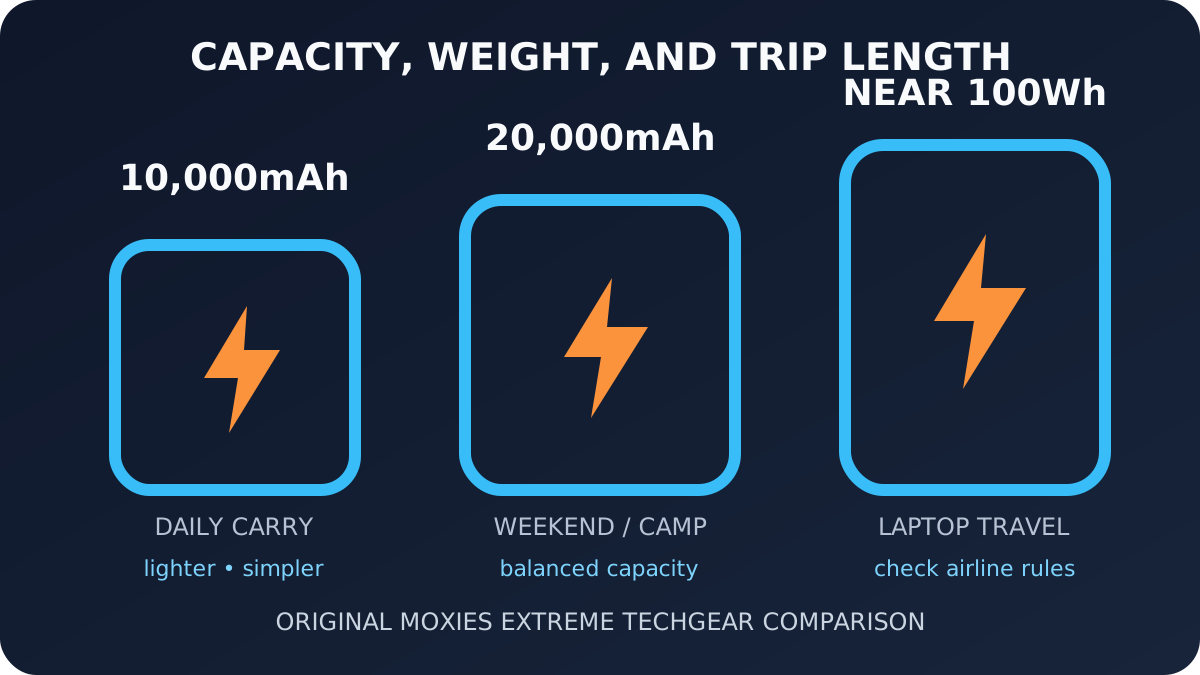
| Rated capacity | Approximate nominal energy* | Best use | Useful output target |
|---|---|---|---|
| 10,000mAh | About 37Wh | Daily phone carry, day hikes, and emergencies | 20–45W USB-C PD |
| 20,000mAh | About 74Wh | Multi-day phone use, tablets, cameras, and handhelds | 45–100W for larger devices |
| 24,000mAh | About 89Wh | Laptop travel with more output headroom | 65–140W matched to the computer |
| About 27,000mAh | Near 100Wh | Maximum practical carry-on capacity | 100W+ when laptop charging matters |
*Illustrative estimates use a common 3.7V nominal cell voltage. Use the printed watt-hour rating for travel decisions. Conversion losses mean the usable USB output will be lower.
Five power banks worth comparing
These are handpicked research starting points, not claims of personal testing. Check the current model’s printed watt-hour rating, output table, dimensions, and airline guidance before purchase or travel.
Nitecore NB10000
A useful comparison point when low weight matters more than laptop-class output, especially for hiking and emergency phone power.
INIU 10,000mAh 45W models
Worth comparing for phones, tablets, and some handheld devices when a compact pack needs more output than basic 20W units.
UGREEN Nexode 20,000mAh 130W
A middle-ground candidate for users who want meaningful laptop output without moving all the way to a near-100Wh pack.
Anker 737 24,000mAh 140W
A strong comparison for compatible USB-C laptops, handheld PCs, and users who value an onboard status display.
Anker Prime 27,650mAh
A maximum-capacity comparison for demanding travel kits, subject to the exact printed watt-hour label and carrier rules.
Why mAh alone can mislead
Milliamp-hours describe charge capacity at a stated voltage; they do not directly show the energy available at a USB output. Watt-hours are more useful for comparing packs and checking airline limits. The basic conversion is Wh = V × Ah. A 20,000mAh pack is 20Ah, and at a 3.7V nominal cell voltage that is about 74Wh.
You will not receive all 74Wh at the charging port. Electronics must convert the battery’s internal voltage to the output requested by the device, and conversion produces heat. Cable loss, high output, temperature, battery age, and charging overhead also reduce usable energy. Treat “number of charges” claims as controlled estimates rather than guarantees.
Output determines what the pack can run
A large battery with a slow port may be disappointing. Phones often work well with 20–30W, tablets and handheld systems may benefit from 30–65W, and many USB-C laptops expect 45–100W or more. Check the maximum output from one port, not just the combined total.
Also inspect the multi-port table. A power bank that advertises 130W total may not maintain laptop-class output when two devices charge together. If pass-through charging is important, confirm that the manufacturer explicitly supports it for your intended use.
Recharge time matters on multi-day trips
A near-100Wh battery paired with a weak input can spend most of a day connected to the wall. Match the pack’s USB-C input capability with a suitable charger and cable. For travel, one higher-power charger can often refill the power bank at night and handle the laptop or phone separately.
Camping and field-charging strategy
For a day hike, low weight usually beats maximum capacity. For a weekend campsite, a 20,000mAh pack can balance capacity and portability for phones, lights, cameras, and navigation. Laptop work, drones, medical accessories, or several people may justify a larger USB-C pack or a separate portable power station.
Using a solar panel
A folding solar panel can refill a power bank when its regulated USB output and the pack’s input are compatible. Real performance varies with sun angle, shade, cloud cover, heat, and panel orientation. Choose the battery first, then size the panel around the pack’s supported input rather than the panel’s optimistic peak rating.
Cold and heat
Lithium batteries temporarily lose performance in cold conditions and age faster when exposed to high heat. Keep a pack insulated but not overheated, avoid leaving it in a hot vehicle, and do not charge a damaged or swollen battery.
The airline rule that matters
FAA guidance treats power banks as spare lithium-ion batteries. They belong in carry-on baggage, not checked baggage. Batteries at or below 100Wh are generally permitted; 101–160Wh require airline approval, and larger spare batteries are not allowed on passenger aircraft. Airlines and international authorities may apply stricter rules.
Choose by use case
Emergency phone backup
Choose a dependable 10,000mAh unit with clear charge indicators and a short, durable cable. Low self-discharge and portability matter more than maximum output.
Tablet or handheld gaming
A 20,000mAh pack with 45–65W USB-C offers a useful balance. Verify whether the device can maintain performance while charging.
USB-C laptop travel
Compare watt-hours, single-port output, and total weight together. A 24,000–27,650mAh pack can provide more runtime, but it is heavier and may sit close to the airline limit.
Camping with several devices
Estimate daily watt-hours for every device, then add a practical reserve. If the total exceeds what one power bank can comfortably supply, a larger power station may be safer than carrying several unlabeled packs.
Buying checklist
- Read the printed Wh rating and keep it visible for travel.
- Match single-port output to the most demanding device.
- Confirm input speed so the pack can recharge overnight.
- Include cable weight when comparing an ultralight kit.
- Check low-current mode if charging earbuds or small accessories.
- Prefer clear safety, warranty, and support information.
- Retire a pack that is swollen, damaged, leaking, or unusually hot.
Frequently asked questions
Can a power bank go in checked luggage?
FAA guidance treats power banks as spare lithium batteries and requires them in carry-on baggage, not checked baggage.
How do I convert mAh to Wh?
Divide milliamp-hours by 1,000 to get amp-hours, then multiply by nominal voltage: watt-hours equal volts multiplied by amp-hours.
Is a 27,000mAh power bank airline-safe?
Many models are designed near 100Wh, but travelers must use the exact watt-hour rating printed by the manufacturer and check their airline’s rules.
How many phone charges will a 20,000mAh power bank provide?
The simple capacity ratio overstates the result because voltage conversion and heat consume energy. Compare watt-hours and allow for real-world conversion loss.
Can a solar panel recharge a USB-C power bank while camping?
Yes, when the panel and power bank support compatible USB-C input, but shade, angle, weather, and panel rating can make real charging much slower than the headline figure.